Showing posts with label Nick Vera. Show all posts
Showing posts with label Nick Vera. Show all posts
Thursday, August 6, 2009
looming.
Everything on ink-link is being put on hold for right now. The founders of ink-link (Adam Gonzales, Chris Avila, and Nick Vera) have come up with something far grander than we ever imagined. It is coming, and it is coming soon. The proportionate size of its epic-ness cannot be even described through words. Keep checking back to see more!

Wednesday, July 8, 2009
new ink-link members wanted.
We at ink-link have decided to add two new members to our team to create an even wider sense of diversity. At the moment we have all decided that a female author would add something to the group that we could not otherwise achieve. We are also looking for another male author as well. You can be a poet, a short-story writer, a novelist; it does not matter. The only requirements we ask are availability to meet at least twice a week to talk over projects and ideas, and residency in the Arizona Chandler/Gilbert area. Please notify us if you are at all interested and send us an excerpt of one of your works so that we can see if you are what we are looking for. We will be notifying our new members as soon as possible! Keep checking back. Thanks! -ink-link inkorporated
steampunk project (project #2).
Our Sci-Fi project has officially ended and we have all been pleased with what we have come up with. As our next project, we have decided to do a Short-Story in the genre of Steampunk. Steampunk is classified as ANY genre with the added ingredient of industrial presence. For example, the movie Wild Wild West is a Western in the genre of Steampunk. Our project will be single space 12 font up to five pages long, and we will not share our exact stories with each other in order to secure originality. Who knows? We may get a fantasy, alternate history, and western from tyhe three of us but all in the genre of Steampunk. So! Have fun and check back from us. We will be posting our stories as soon as Nick gets back from Chicago, so it'll be a few weeks. Keep checking back though! Thanks! -Adam
Saturday, July 4, 2009
multiply.
The clouded skies reflected upon the aviators swerved like a gelatin in the tinted glass, and the leather glove tightened around Dimitri’s hand as his fingers curled around the handlebar. Gravel and dust from the New Mexico desert blemished the empty freeway and traveled along with the force of the storm’s wind. Dimitri studied the long straightforward road from behind his aviators. His short black hair tousled with the rushing breezes; his brown jacket waved as well, and as the Harley ’94 peaked 120 mph the storm began to pick up momentum.
A gust of cool wind from South of the desert had begun to travel towards Dimitri, picking up grains of dirt and pollen, and neared closer and closer until it struck a significant blow. Dimitri struggled with the motorcycle. He clenched the handlebars amid his gloved hands, and maneuvered the vehicle back on path. With careful thought, he anticipated more impact from the storm’s wind, and was more cautious to the handling of his drive.
He turned his head to the right where most of the dark clouds had formatted. The motorcycle’s engine continued to purr as it journeyed passed more and more road, but suddenly the noise began to rupture. Brief moments of failure began to interrupt the consistent engine.
“Perfect.” Dimitri shifted his head back towards the road, and glanced over at the gauges in the dash. Nothing of alert was being noticed by the car.
Then, the stalling began to take its course. The pauses took longer; the engine made effort to continue the steady path, but to no prevail. Gently the vehicle began to decelerate, and the orange indicator on the speedometer declined. 120...110...105…
“Thanks, Grandpa,” Dimitri said to himself, “you sure have a way with bikes.”
Dimitri pulled to the right shoulder of th
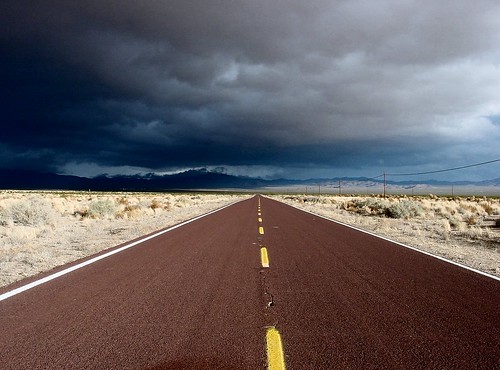 e long deserted road, and coiled his fingers upon the brakes. The rugged black motorcycle came to an easy halt, and Dimitri mounted off.
“Least it’s rainin’,” he looked up at the gray sky. Raindrops landed on his tinted lenses. As he wiped his aviators clean, Dimitri ambled to the item compartment on the back of the motorcycle. He unlocked the tiny stainless steel box–sprinkled with rain–and opened the compartment. Inside, spare pistol bullets, an August issue of Maxim, a folded miniature atlas, and a picture displaying a young girl with black hair was placed.
He took the tiny picture and gazed at it. A nostalgic wind gusted through the desert highway now, yet it remains a mystery what emotion was felt behind Dimitri's aviators. Soon enough, the storm’s rain began to land on the photo, and, as a cue, Dimitri pocketed the picture, picked up the tiny atlas, and unfolded it.
“Come on, little map,” whispered Dimitri; a violent bolt of lightning crackled in the background, “find me a Texaco.”
As he searched down the highway lines in the map, the rain began to fall harder. A sudden urgency filled the atmosphere, and the raindrops grew heavy. They parachuted down from the skies on Dimitri, falling and picking up speed. They began to freeze and crystallize in the sky. Hail. Suddenly, Dimitri was bombarded by a fleet of descending ice. He used the atlas to shield his head from the plaguing hail, but another torrential gust swept it away. The atlas now traveled through the air, manipulated by the behemoth winds, and was sent zig-zagging across the emptiness and dull dirt of the desert land.
Dimitri, realizing that the atlas was his only aid of direction, chased after the escaping map. His leather shoes imprinted the ground with the pattern on the soles. Shocks of pain from the hail hindered his balance, and Dimitri fell to the hard, damp ground, but stumbled back quickly to his feet. In pursuit–and in pain–he was cautious of what occupied the floor to prevent tripping again. Then, a cataclysmic, intimating boom that ravaged all noise with such amplitude bewildered Dimitri, and he fell once more. This time, leaving the atlas to lose itself amongst the wind.
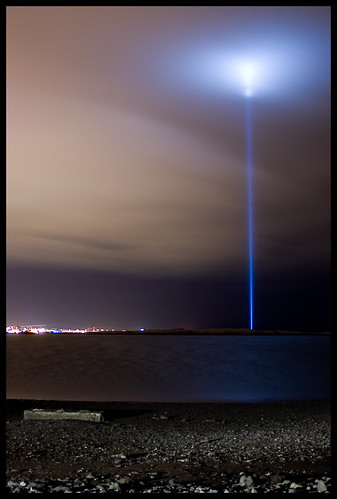
Dimitri's energy was almost completely gone. It took effort to raise his face from the rough desert dirt. Veins in his neck pulsated as he raised his head, and he began to scan the clouded sky–with great difficulty due to the hail–for the map. Through his aviators, he frantically searched for his atlas, but aborted when his eyes constricted to the sight of the marvelous blue glow. A thick, jurassic, glowing obelisk of blue light fell from parted gray clouds seeming to land a few miles in front of Dimitri.
That must have been what caused the boom, Dimitri thought. The hail seemed to have calmed now, and the storm seemed less violent since the glowing rod surged from the sky. Nothing was left but the silence of awe and wonder.
As he laid there, galvanized by the unearthly marvel, aggression was evoked in the winds once more. This time with a more vicious strength. The winds began to pillage the once-tousled hair, and ransack the brown jacket. Then, the unscrupulous force physically began to violently drag Dimitri towards the beam. He skidded across the rough ground trampling dead cacti and empty carcasses. The bare skin behind his clothes were scraping against the irregular surface of the desert; pieces of skin dislodged and left open, painful, bleeding wounds.
He was being pushed closer and closer to the obscuring beam. Every now and then, he would skid on the heels of his shoes in an attempt to brace himself from the forcing motion with no use. Dimitri was closing in on the root of the beam. The aviators helped him see through the bright mystic azure glow, and as he was so close to the mysterious gargantuan light that he could almost touch it the wind halted, and he plummeted to a stop.
Once again, he stumbled back on to his feet, and was just arms-length away to the radiance. Curious to how the light must feel, Dimitri raised his finger and neared it towards the light.
“I would not touch that,” a booming voice commanded from behind Dimitri.
He turned in fright, focusing his eyes through the lenses, and searched for the voice.
“Where are you?” Dimitri yelled towards the emptiness.
“Behind you,” the voice sounded closer to Dimitri’s ear now.
Dimitri turned again quickly, and came face-to-face with a blue-eyed man.
“Who are you!” Dimitri shouted.
“There is no need for exclamations,” the man said, calmly, “I promise you. We–”
“We?” Dimitri interrupted as he gathered his breathe. “There’s more of you?”
“Yes,” he smiled, and his blue eyes lit up, “And we come in peace.”
Dimitri gathered his speeding thoughts, “Talk about cliche.”
A wrinkled smile formed on the mysterious man face. He held up a feeble hand towards Dimitri, “I can explain more, human. Please, take my hand.”
Dimitri’s irregular breathing grew hotter with frustration. He glared at the man’s hand, “What?”
“My boy, take my hand so I may show you.”
“Get the heck away from me,” his voice melted with spite, “I don’t know who you are.”
“I can explain all in due time–”
“I don’t know where you’re from, I don’t know what this whole blue-light thing is.”
“My boy–”
“And I’m sure as hell not holding your hand, old man!”
“Son,” the man with the blue eyes put his hand on his shoulder, “you’re delusional.”
“I said get the he–”
Suddenly, a bright blue, blinding flash of light filled the entire setting. A rush of motion passed through Dimitri's finger tips. His stomach rose to his throat and churned with the feeling. The ground from underneath his feet was gone, and Demitri felt as though he was falling and standing simultaneously. Then, abruptly, a wave of black darkness flooded Dimitri's eyes. He felt gone.
* * *
“Man, Stanley, this storm is crazy. Sure would hate to be the guy caught in this rain,” a regular said within his stool. He grasped his cold mug of foaming beer in his hand, and sipped the cold alcohol. “Anything on the news ‘bout it?”
“Let’s check.” The bartender turned the dial on a dusty television set on a shelf. The screen lit up, and the local news casting program was on.
“That’s right, Robert. A class-five state of emergency has been called here at New Mexico,” the woman on the television reported.
“Hah, state of emergency! I laugh at the silly folk who are afraid of a lil’ rain,” the bartender smiled.
“Now hold on there, Stan, I have kids at home,” the regular’s eyes widened with fright, “Has New Mexico ever gotten hit by a hurricane?”
“No, stupid, we live in a desert! There’s no water here!”
“What about tornadoes? What about earthquakes!”
“Sush it, Kevin!” the two looked back up at the television. Footage of a massive crafts hovering above the sky had been playing since. The grainy amateur capture caused the colors of the clouded sky and the crafts to blend in, making it hard to differentiate. Towards the end of the footage, the cameraman points the camera straight up to see a craft incredibly close to the ground. He scans the craft with the camera, and focuses in on a hole aligned to where he’s standing. Suddenly, the hole lights up with the ominous blue glow, and the camera is dropped.
“Once again, that was disturbing footage from earlier today in Cancun, Mexico,” the television announced.
Suddenly the television interrupted the news broadcast. A strange blue logo that looked like skull was displayed for a brief two seconds. Then, an elderly looking man with glowing blue eyes was facing the screen.
“Wow, he sure does look strange, Stan,” said Kevin.
“Must be the Japanese again…” said the bartender.
“We mean no harm, Earth,” the voice boomed from the television, “and on behalf on the Velascian race, we apologize for interrupting your inferior human activities. My name is Threon, I am chief linguistic of my people. We have studied your planet’s language, culture, and weaknesses in order to save it.”
“I don’t think these are the Japanese, Stanley…”
“Reoccurring trends in the galaxies ionic patterns suggest that your planet is conflicting its very existence with another paralleling planet. To put it bluntly, your all going to die.”
“This guy’s serious…”
“Worry is unnecessary. We have already taken precautions to preserve the human race.”
“Drink up, we’re gonna need it.”
“We have chosen two members of your race that inhibit all the traits of high-quality reproduction systems to multiply. One male by the name of Dimitri Escon, and a female by the name of Veronica Esquet. The two are with us. You have three minutes to live. Goodbye.”
The television fell silent. The entire bar fell silent. Only the two men inhabited the restaurant, and they each silently took the news in. After a few seconds, the bartender took the mugs, refilled them, and handed one to Kevin.
“To us,” Stanley raised his mug for a toast.
“To us.”
Tuesday, June 30, 2009
the ravine, the sticks.
This was a little short story I wrote in a single hour at 6 in the morning after pulling an all-nighter. I was spending the entire night searching the internet and reading Stephen King's "On Writing." The book is truly remarkable, and King offers a wide variety of advice on the art of writing. One of the greatest tips he gave on creative writing was to start off with a character and then just let him live. So here was my experimentation of just starting with a character, and letting the story unfold itself. NOTE: This story may be a lot of typos, due to the state of mind I was in when writing it (I pulled an all-nighter!). Enjoy!
Half-and-half was the coffee type best suited for the journey. Caffeine-powered energy circulated throughout the nervous muscle system. The surface rippled as the decrepit wooden paddle stroked the ravine's still water, sweat accumulated on the brow of the white-haired boatman; agitated by the ambiguous sting in his eye–yet paddled onward. The road ahead: the only passage available to getting to the boatman's "home," was prolonging. The ravine tested tolerance.He raised his chrome thermos to his large and violently pink lips. As the hazel coffee grazed his chapped lips, the man took notice of the mist surrounding his vessel. The boatman–although tolerable–was agitated with the mind settings of yesterdays and the previous, despite the relaxing waft of the ravine current. Paddling, stronger, faster, towards the mist: which once soared at the heavens; the boatman reminisces of skeletons from the past. Resilience to forget–the punishment for a guilty conscience.
More impulsive, his strokes began to turn. Steady ripples now turned to light splashes; the rowboat now tilted and turned with a faster, more complex rhythm. Veins tightened within his arms, wrists, and shoulders: frail, like any elder senior–patiently waiting for the final rest.
Shortly, pain crept into the consciousness of the boatman and he aborted his frantic paddling. Resuming a sense of tranquility, the boatman released the paddle–midway below water–from his firm grip; allowing the utility to float on–far from him. He let go, permitted peace to gather, and allowed the current to guide.
"There ain't no use," he screamed to the mist, "I can't run away."
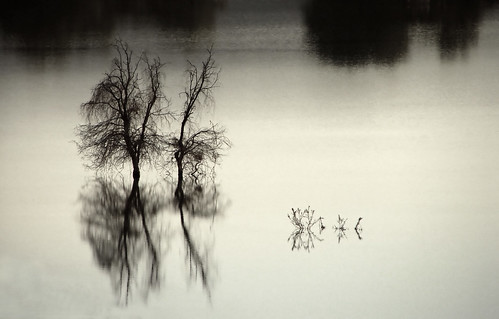
Nearby stalks of plants–peeking above the water's surface–bent to the strong, sudden draft of wind, which has manipulated the vessel; it steered the boatman deeper into the vague obscurity of the mist. The boatman refrains from tears; congenitally, crying in any situation was a niche for weakness. He kept his eyes resistant to–his own–perception of this eldritch phenomenon. Yet, no senile man in his late 80's could resist what the boatman saw next.
Deeper and deeper, the wind emphatically guided the boatman into the mist. The surface tension began breaking and reassembling with the speed of trek of the vessel. And suddenly–a stop. The contemporary stillness and tranquility temporarily revisited the boatman again. He takes advantage of the calm; as still as the stars assigned to the sky–and takes a last profound and long breathe of chilled mist. His caffeine-stimulated muscle attempt relaxation–unknowing to the boatman his body was going a mile a minute–but, at the inhale, a gentle "thud" is heard from below the raft. The boatman peaks towards the edge of the rowboat–and his cardiac, ventricle, and muscle system reach the speed threshold. His body: a light bulb burnt out after it's final switch-on, a manual motor grinding it's gears, the putting out of a candle–fell into the still and peaceful waters; he floated next to the corpse of a women: in the early stages of decay–larva already picking out at her large and, what was once, violent pink lips.
With only the last final tremors of the boatman; they both rested, calmy and tranquil, atop the ravine–allowing the mysteries of the mist to engulf them.
Tuesday, June 23, 2009
sci-fi project (project #1).
Nick had the privilege of choosing our first writing project. We are taking on the challenge of writing a Sci-Fi piece under the strict rules that it cannot be more than four pages single spaced. This way you can see how each of is gets a beginning, middle, and end within the same amount of space. We will be posting at the end of next week, and each of our pieces will be COMPLETELY different due to the fact that neither of the other two will see what the others have written until it has been posted on the blog. Check back at the end of next week for our projects, and keep checking back daily to see works that we have already written and that will be posted on the site. Thanks! -Adam
victor vacinni.

No one ever grew fond of Victor Vacinni. Amid our preadolescence years and elementary era, middle school society conformed to the norm of growing use to someone; Victor Vacinni was an exception. In classes, we usually found him–glassy eyed and nosed stuffed–staring straight at someone: no blinking, no nonchalant glances at the ceilings. At lunch, his isolation often disturbed our ability to eat with tranquility. He sat there, in his own empty table, staring straight at one of us: no blinking.
We all had our reasons to feel uncomfortable near him. Daniel Clemens once told us that they both attended the same private preschool and he would perform acts of passive-aggressive sexual exploitation. “He would take off all the clothes of the girl’s Barbies and draw all the privates where they should be,” he reported to us, during one of our many lunch-table gatherings, “When our teacher caught him Sharpie-ing a penis onto a Ken, he told her that he liked things to be realistic.” Sunny Days Preschool admits students from age four to six; Victor was five in Daniel’s testimony. Jared Stewart cited another example of Victor’s odd behavior at a viewing of The Godfather. “We went to the same church when I was eight,” he said, taking a swig of his soda, “every time the pastor would want us to repeat a passage, he would always talk in tongues. To this day, I don’t know if he was faking it or if he was actually possessed by something.”
Chris Peters once recalled an event where he was rehearsing through another laborious period of biology–which he and Victor both attended–and, unfortunately, had the pleasure of sitting by him. Here, Chris, the opportunist that he was, paid careful attention to the physical aspects of Victor. “He looks even crazier up close, man,” he said, lighting a cigarette as we all huddled behind our high school bleachers one Sunday afternoon, “that crazy bastard had two lazy bright brown eyes. I remember Mrs. Smith, dumb braud, told the whole class to ‘converse’ with each other about decomposition or something. Hell, I needed to pass, so I talked to him, but as soon as I uttered a word he got really close, like this,” he got as close as he could to Johnny Carlson’s face; the tip of his cigarette brightened as it inched closer and closer to Johnny’s nose, “About this fucking close that creep-o got. Tell you all, I never seen so much disgusting hygiene on a kid before. Fuck, I’ve seen roadkill cleaner than that boy.” We all urged him to go on. “His snot: wet and dry. You could notice the dried up layer because it was magnified, like a jello, by the running wet snot falling and gathering up on his upper lip. His skin was greasy and reminded me of an old leather wallet. God damn it, man, I’ve never been so disgusted by a person in my life.”
We all formed separate opinions on one or two differing physical traits he held. Jared Stewart recognizes Victor the most for his sporadic hair lining, “It’s the type of hair lining where your only hope to pull it off is to completely shave it.” Daniel Clemens remembers him for the huge bug eyes he had, “They always look as though they capture the light in the room. It has a strange gloss to it.” Robert Miller recalls his mangy posture and the way he raised his wrist to chest level. Rudy Romeo juxtaposes Victor’s unspeakably high voice and his greasy curly hair. Kevin McDonald, his scrawny legs. Tyler Beard, his skinniness. Taylor Jackson: big cheeks. Johnny Carlson: mongoloid teeth. Chris Peters: snot.
Every lunch, we all sat parallel to his empty kingdom. Victor never ate; he stared. It was a silent mutual rule that none of us ever bring up his prolonged gaze towards us at the table. We would either burst out into false laughter from Chris’s naughty joke or made fun of eachother; We all looked for ways to conceal the discomfort of his stare.
Once, during an after school detention, Chris Peters and Taylor Jackson decided to amuse the two-hours of confinement away by passing notes. It started with a game of hangman inscribed into the college-ruled by granite pencils. The frustration of guessing, the silent laughter with the eyes, and the lingering hint of boredom at the innocent entertainment evolved the topic, evoked into the wadded up paper ball, to the taboo that was Victor Vacinni. First, a drawing of Victor with the more cartoonist angle. Chris exaggerated his odd shaped head, his bug eyes, and payed the most attention to the running snot. Taylor added labels and arrows such as: tiny dick, shit-stained pants, unzipped zipper–each arrow pointed to the appropriate anatomy location. The mocking within the note escalated with such a speed that the velocity sped up the detention time itself, but before the last two minutes of their sentence Taylor wrote one last thing into the flagrant note: Victor Vacinni is gay.
“I threw it out,” said Taylor, when we all asked while walking at a mall one evening, “someone might have picked it up.” Whatever the cause, the rumor permeated through every hall of middle school. The topic penetrated every gossip requiem the day prior. ‘Victor Vacinni is gay’ invaded the notes passed, in secret, throughout classes. The questioning of Victor’s sexuality spread faster than the medieval Black Plague, carried out by rats and maggots, infecting virgins to the news. It was a God damn epidemic.
Maybe it was bias on knowing that we spread the rumor, but Victor’s gaze at the cafeteria seemed more concentrated since. We all knew laughing loudly or telling an irrelevant story wouldn’t cover up the tension amid our sandwich eating and the glare, so we feasted in silence those days–the days the news was still saran wrapped. “You remember that one day, when everyone, like, made fun of him during fifth period and all he did during lunch was stare at us and write in some weird notebook?” said Tyler Beard, in a reminiscing moment we all shared during a lull in a road trip.
All of us produced theories of what he might have written in the notebook. Daniel thought he was compiling a hit list. “Come on, guys, he had all the motives to want to kill us. He was a major creep and he probably knew about the note that started it all,” said Daniel once, ill in bed. Kevin McDonald speculated that perhaps Victor was an artistic individual, and was simply jotting down his emotions. “Nothing great, in art, is ever produced through happiness,” Kevin stated, as we all drank coffee at a Starbucks, “the haunting experience may have been perfect inspiration for a piece.”
Over time, we all abandoned justifying the mysterious writing. Over time, we resumed our obnoxious laughter and mechanisms to refute the discomfort. We all continued digging into our lunches, our Pringles, Cheetos, carrot sticks. None of us could resist the thought that we were silently mocking the kid as we ate. Here we were: eating. There he was: alone.
However, our middle-school mystery of Victor Vacinni was answered by Mrs. Devila–our study period advisor. We all notice that he was gone that day at school. “I knew that day was gonna be really fucking weird. He was never absent at school, never,” Chris stated to us, beneath the bleachers, dropping the cigarette stub and extinguishing it with his foot, “it was ironic ya know. The thing more creepier than him being at school was him being absent from it.” The classroom air had a mundane chill the day we all received the news about Victor Vacinni. “You know ever since preschool, that kid always sent an eery warmth into the atmosphere. Like a dying animal breathing his last warm breath,” said Daniel Clemens as we all packed our left-overs of lunch and placed a tip for the waitress. The distinct facial expression Mrs. Devila wore, as she stepped up from her desk onto the center of the room–we all remembered that look, the look of sympathy and mourn. “Tell you one thing, our middle-school teacher was a heartless bitch, the way she gave us the news felt so forced. It’s a shame. No one ever liked that kid. The teachers had to act,” said Jared Stewart, as the movie credits fell and we begun to exit the theatre. We all remembered how we simultaneously stopped talking and turned in our chairs to face her. “She always use to complain about how we never stopped talking. I wonder why that day we all did,” yawned Tyler Beard, as he approached sleepiness and began to rest in the backseat of our car.
“Ladies and gentlemen,” said Mrs. Devila, “I am sorry to inform you that Victor Vacinni will not be joining us any further,” that long pause, “Due to some graphic news that was sent out into the school today, it was brought to our attention that Victor is no longer with us. He died. I have been taken aback by the news that his life was taken,” another lull, “by his father.”
“His father apparently was some psycho murderer.”
“Fucking tells you a lot about why Victor was the way he was, huh?”
“The father,” Mrs. Devila now crossed her arms: body language for sincerity, “was arrested this morning, and, rest assured, he has been imprisoned and will not harm anyone ever again. A notice to each of your parents has been sent out to bring this to there attention.”
“Makes you think.”
“Why do you think we never stopped messing with him? Wasn’t it obvious this kid had problems?”
“We were kids, man, we were kids.”
We all waited through Mrs. Devila’s longer pause, and then she stated, “Let’s all take a minute in silence, to remember Victor Vacinni.”
snapshot.
Twelve years old and the picture is as perfect as the day it was taken; despite the conspicuous coffee stains, smudgy ink, and the deteriorating corners, the Polaroid  print inhabiting my side table drawer waited for twelve years. As the digital alarm clock, playing centerpiece to my wooden side table, counted the hours, as the moon and sun continuously fluxed roles, as I learned math, writing, and how to read, the photograph lay waiting until this very day. I grasp the brass drawer handle amid my fingers; the mahogany drawer creaks as it struggles through the rusting under track and–as though opening a window to show a forgotten autumn view–I see my young self: embraced by a tiny young girl.
“Attention deficient?” she stated with a proclivity for suggestion.
“No. My boy doesn’t have a disorder. He’s just--.”
“Mildly energetic? Hyperactive? Prone to tantrums?” my teacher’s inclinations were nothing short of subtle, of course.
“His father likes to call it creativity,” my mother begun to rise from the seat, heading towards the door; she takes me by the hand again, “Why isn’t he off the walls now, huh?”
“He’s obviously scared he’s in trouble, right little Matty?” she shifted her tone at the end, attempting to appeal to my childish behavior–I knew better; I remained mute, “your boy hasn’t done a single cooperative or productive thing all year. He constantly picks on his classmates and throws toys around for fun. He never sleeps during nap time, he never stops talking, he never tries to stay on task! Tell me, do you see him show any signs of attention or focus at home?”
My mother hesitates, scavenging for a previous demonstration of academic trait, “Yes.”
“When?” my teacher retorted, snootily.
“When he’s with our next door neighbor’s daughter, that’s when,” she succumbed to the excitement of discovering my niche, “he tells her stories about adventures and shows all the time. They make up games together and they’re just the two most creative kids I’ve ever met!”
I abort my evocative stream of conscious memories–focusing now on the task at hand. Around my neck, a Polaroid–I own in antiquity–hangs by a black strap, laying gently on my chest as I sit on my bed. Reaching into my jean pocket, I unfold a flier. It informs about a photography contest being held; winners earn a free vacation anywhere in the United States. Theme: innocence.
The photograph I hold is gorgeous. Lighting: spot on–the color of the autumn trees in the background compliment our eyes. Her arms bide me from behind. A perfect snapshot–yet unqualified; the contest is strict. No coffee stains allowed.
We were both located in her backyard: plastic balls, hula-hoops,UPS packaging boxes, and technicolor chalk–scattered through the 20-acre wonderland. Goldenrod rays flooded the land–along with my yard, right next door–and everything glowed mystically. The sun, right above, sent the illusion of golden highlights falling, spiraling, as she moved, through her beautiful curly hair.
“Well…” I stretched the “L” sound; like lightning, I started zipping through my young thoughts, scavenging for something to amuse her, “she said I was a genius, and should move to genius school!”
“No way!” her eyes beamed with the goldenrod light that shined down on her; she didn’t want to believe it, but in earlier minds our imaginations manifest reality.
“Yeah way!” I looked straight into her eyes–to ignite belief, “and I can prove it, too!”
Her smile divulged her dimples; she clenched her teeth as she giggled, “Nuh uh.”
“Ya huh, ask me a question!”
“What kinda question?”
“Umm,” I think like a genius, “ a’ ar’thimetic one! Math!”
“Hmm, okay,” she pondered for a moment and her eyes gleamed again, “what’s a bajillion times five-million bajillion?”
“Easy,” with narcissistic lingo, to trick her, “two-million quadrillion,” I pause for dramatic effect, to prolong applause, to accumulate anticipation, “and one.”
She giggles hysterically at the punch line; I looked into her eyes and her face scrunched up as she smiled–for odd reasons, I smiled back.
“My teacher also said something else,” although two young to acknowledge–my heart began racing, multiplying two-million quadrillion and one times faster.
“Oh yeah?” she smiled again, prepared for another set-up; the gold glares in her hair undulated like a contained jello, “What else?”
“She said I’m quite the smoocher,” I tried to keep an earnest face, any sign of a humorous emotion–God forbid a blush–could jeopardize my entire devious ruse.
“What?!” she was in sheer shock and her jaw dropped like a cartoon, “how would she know?!”
Improvising again, “We were doing a kissing project,” a trait I still carry to this day: compulsive lying, “we had to kiss apples and pears and I did the best.”
“Oh my gosh,” she giggled again, hysterically, “that’s unbelievable.”
“Believe it,” I said, solemnly.
A lull–then, “I never kissed anyone before.”
“Me neither,” I stated.
At five years, a child can’t decipher an intimate moment from anything else in the world, but the biology usually stays the same. My veins constricted, blood rushed faster. I scanned for any parental unit within view. I take a step closer to her; my foot barely missing a mature dandelion grown atop the green grass. Beneath our slowly attracting feet, another action occured; a tiny yellow bee–leftover from the summer–began to nestle onto the delicate weed. The insect hovered, dropping altitude, closer and closer to the dandelion; I remember her dimpled cheeks getting closer and closer to mine.
The camera begins humming, configuring, manufacturing the snapshot. Through the Polaroid outlet slot, an image ejects–printed upon a gloss coated sheet. I redeem the photograph from my hanging camera; the image taken is horrendous: too saturated, stray winds catching blades of grass producing negative and unbalanced effects.
It was cold. My fingers ached. It became hard to simply take a picture. The damp grass sloshes as I travel across the green-belt. All my life I’ve traveled across suburbs; These minuscule societies built on bricks of prosperity, progression, and the perfect industrial family–yet why couldn’t I capture innocence?
Rusted chain creaks accompany the sound of an accelerating wind, as a swing set imitates a descending pendulum. Beneath my chilled toes, the sound of moist grass resides for the audibility of crunching wood chips. Through the lens, I see a lonely park; Gray clouds begin to accumulate in the sky and a bead of fallen rain hits the camera. I drop the Polaroid–allowing the neck strap to catch it.
As the dim fluorescent television glow brightened her face, she told me about her worries. She feared starting elementary school, not making any friends, or getting bullied; Our personalities were complete opposites. I laughed at her phobias and assured her they were nothing. She believe me and we watched a cartoon–filling the commercials with our own laughter.
As a decade old male, lifting cardboard boxes filled with household utilities came easy; the same could not be said for Natalie: a nine year old female. I loaded, going back and forth between front porch, sidewalk, then U-Haul, Natalie helped me. In frustration she said, “Matty, you dork, help me with this box!”
Annoyed, I laid my box down on the concrete sidewalk. Catching a glimpse of the label on her box, I grew irritated. “Tupperware…” I paused for dramatic effect, “You need help carrying tupperware, really?”
“Oh, don’t talk high and mighty with me, mister I-can-never-play-cause-I’m-exhausted!” she retorted.
I couldn’t wait until every material possession I owned was in that U-Haul. My family and I were leaving this small suburban home for a bigger one, closer to the city, with more room. I didn’t want to leave Natalie forever–just a break. It was agreed that monthly visits would be made.
The afternoon continued similar to this: She whined; I whined. Gradually, the boxes stacked atop each other within the storage, building piles, and as the orange sunset descended beneath the horizon, my father closed the U-Haul, ready to leave, but not completely. My mother and father already gave their goodbyes to Natalie’s parents; they were in the van. I approached the family automobile and got in.
“Hey Matt,” my father said from the driver seat, “I’d say bye to Natalie if I were you.”
Deciding to obey, I exited the car, and climbed up her front porch steps to press the doorbell. Seconds after the gentle tune filled her house, the door opened and the dim glow of the autumn sunset was enough to see her face; It looked as though she was crying.
“Bye,” I said, generically.
“Bye,” her voice cracked slightly.
I was speechless; I wanted to leave, so I began to turn, but her hand clenched my shoulder. She turned me around and embraced me. The sunset finally gave way to moonlight–and it was silent.
“I’ll visit you every month,” she promised.
She was playing with my little sister in the room next to mine; Our new house was a lot more spacious, but sound seemed to reach me faster. I opened the white dry-wall door, two girls were dancing and whistling to the tune of a song I don’t remember.
“Natalie!” I half-shouted.
She stopped the noise and dance, my sister followed. Turning, she looked at me and half-shot me a smile, “What’s wrong?”
“Uh…” I attempted to sound nicer, “I have to do homework. Can you guys be quiet,” a hesitation, “please?”
“Oh,” she sounded taken aback, “alright.”
The next two hours I did my work in silence, the occasional laughter here and there; I tolerated. After work was finished, my phone rings: a girl from my middle school. At age 11, you’re all too aware of an intimate opportunity.
I could still hear the other two in my sisters room at nighttime. It was cold. My fingers felt numb as I held the phone: talking to a girl I don’t remember, wishing it was still daytime. Fourteen minutes invested into the phone, I heard a gentle thud on my door. Suspicion alerted me, Natalie is up to something.
With the simple, “Hey can I call you back?” I paused the conversation. Suddenly, the door flung open before I got to the handle, hitting me on the forehead. Natalie entered my room laughing, oblivious to my injury.
“Hey Matty!” she yelled obnoxiously; I grew frustrated. How dare she made me hold a call, “Who was the girl you were talking to? Your new lover?”
It was a mixture of pain, intolerance, and catalytic brewing of the hormones.
“Your voice rattles when you talk to her!” she laughed.
It was a mixture of accumulating annoyance, anger, pain.
“You even try to make little cutesy phrases,” she went nuts.
It was a highly saturated, horribly lit, and unimpressive cocktail.
“Shut up!” I broke, “Shut the hell up, okay?”
She’s silent.
“You annoy me! You’ve gotten on my nerves since the day I met you! You dumb little cooz!” the biology stays the same for teenagers too: adrenaline.
She’s silent.
“You’ve gotten on my nerves since grade school when we walked home… and it just keeps getting worst!”
She cried.
“I hate you! Get out of my life! I want nothing to do with you!”
All these photos suck.
The ring ceased and silence returned to my room. There I stood, aimlessly scanning for the handheld. Suddenly, another ring intruded: quieter, quicker.
Voicemail received.
Minutes later I found it beneath the mattress, and I played the message: Hi Matty, this is Natalie. Uh… I just called to say happy birthday. I didn’t forget it was today… twelve years old. Congratulations buddy… I really miss you. A lot. And I miss being around you. And I want to hear from you. And… and… I love you and just wanted to say ‘hi.’ Bye Matty… call me back as soon as you can.
Currently I hold a manilla folder from Flickr Inc.; I tear it apart. I unfold the letter. I read: “We regret to inform you that your photograph is unqualified for judging due to coffee stains.”
The goldenrod, filtered by the autumn leaves branching from the oaks, grazed our heads as Natalie and I adjusted ourselves in front of the Polaroid.
“This is the coolest gift ever!” I stated, referring to the camera.
“You’re welcome, sweetheart. Now stay still so I can get you two in this picture correctly.” We waited for another minute; Natalie’s mother struggled to turn off the flash.
Behind us, our suburbia was enriched by autumn leaves drizzling with the light wind. The golden grasses of our front lawns complimented the autumn-leaf showers. A cricket nearby played a tune–a tune I no longer remember, only that it was joyous. The smiles we formed just laughing about stupid 5-year-old stuff.
“Okay ready?”
We prepared our pose: magazine smiles and silly eyes.
“One.”
“Two.”
“Say cheese… and…”
I felt Natalie’s arms suddenly flung onto my biceps, embracing me from behind and to a complete shock my magazine smiles turned genuine.
We heard clicks; We heard noise.
And a picture perfect photograph was ejected.
print inhabiting my side table drawer waited for twelve years. As the digital alarm clock, playing centerpiece to my wooden side table, counted the hours, as the moon and sun continuously fluxed roles, as I learned math, writing, and how to read, the photograph lay waiting until this very day. I grasp the brass drawer handle amid my fingers; the mahogany drawer creaks as it struggles through the rusting under track and–as though opening a window to show a forgotten autumn view–I see my young self: embraced by a tiny young girl.* * *
It awed me to watch the green chlorophyll-pigment escape a divine leaf; It awed me more to witness the yellowish-red autumn take over. My mother’s freshly manicured nails gently nicked me as she held my five-year-old fingers. We walked on the familiar suburban road on our way to my old day care where, the day previous, I had misbehaved. In my left hand, I held an autumn leaf–examining the changes that had been taking place. To my right, a slight timbre in my mother’s walk instructed me to stay silent–to not rattle a cage. People back then had the unanimous description of me as:“Wild and uncontrollable!” shouted my pre-school teacher: a women, I no longer know the name of. My mother and I took a seat, resting upon the surface of the plastic glossy-red chairs: uncomfortable and–to a child–indestructible.
“We try controlling him,” my mother defended, with her infamous passive-aggressive tone, “but he’s just so… so…”“Attention deficient?” she stated with a proclivity for suggestion.
“No. My boy doesn’t have a disorder. He’s just--.”
“Mildly energetic? Hyperactive? Prone to tantrums?” my teacher’s inclinations were nothing short of subtle, of course.
“His father likes to call it creativity,” my mother begun to rise from the seat, heading towards the door; she takes me by the hand again, “Why isn’t he off the walls now, huh?”
“He’s obviously scared he’s in trouble, right little Matty?” she shifted her tone at the end, attempting to appeal to my childish behavior–I knew better; I remained mute, “your boy hasn’t done a single cooperative or productive thing all year. He constantly picks on his classmates and throws toys around for fun. He never sleeps during nap time, he never stops talking, he never tries to stay on task! Tell me, do you see him show any signs of attention or focus at home?”
My mother hesitates, scavenging for a previous demonstration of academic trait, “Yes.”
“When?” my teacher retorted, snootily.
“When he’s with our next door neighbor’s daughter, that’s when,” she succumbed to the excitement of discovering my niche, “he tells her stories about adventures and shows all the time. They make up games together and they’re just the two most creative kids I’ve ever met!”
* * *
Nostalgia evokes my mind as I stare into Natalie’s young brown eyes in the photo. I remember–as I see–the prepossessing curly brown hair of my first little audience member. Her widely eclectic lips would smile; they would depress the dimples that symmetrically sunk beneath her tiny tannish cheeks as she applauded for me–all captured in frozen image.I abort my evocative stream of conscious memories–focusing now on the task at hand. Around my neck, a Polaroid–I own in antiquity–hangs by a black strap, laying gently on my chest as I sit on my bed. Reaching into my jean pocket, I unfold a flier. It informs about a photography contest being held; winners earn a free vacation anywhere in the United States. Theme: innocence.
The photograph I hold is gorgeous. Lighting: spot on–the color of the autumn trees in the background compliment our eyes. Her arms bide me from behind. A perfect snapshot–yet unqualified; the contest is strict. No coffee stains allowed.
* * *
“What did she say?” Natalie asked, referring to my teacher.We were both located in her backyard: plastic balls, hula-hoops,UPS packaging boxes, and technicolor chalk–scattered through the 20-acre wonderland. Goldenrod rays flooded the land–along with my yard, right next door–and everything glowed mystically. The sun, right above, sent the illusion of golden highlights falling, spiraling, as she moved, through her beautiful curly hair.
“Well…” I stretched the “L” sound; like lightning, I started zipping through my young thoughts, scavenging for something to amuse her, “she said I was a genius, and should move to genius school!”
“No way!” her eyes beamed with the goldenrod light that shined down on her; she didn’t want to believe it, but in earlier minds our imaginations manifest reality.
“Yeah way!” I looked straight into her eyes–to ignite belief, “and I can prove it, too!”
Her smile divulged her dimples; she clenched her teeth as she giggled, “Nuh uh.”
“Ya huh, ask me a question!”
“What kinda question?”
“Umm,” I think like a genius, “ a’ ar’thimetic one! Math!”
“Hmm, okay,” she pondered for a moment and her eyes gleamed again, “what’s a bajillion times five-million bajillion?”
“Easy,” with narcissistic lingo, to trick her, “two-million quadrillion,” I pause for dramatic effect, to prolong applause, to accumulate anticipation, “and one.”
She giggles hysterically at the punch line; I looked into her eyes and her face scrunched up as she smiled–for odd reasons, I smiled back.
“My teacher also said something else,” although two young to acknowledge–my heart began racing, multiplying two-million quadrillion and one times faster.
“Oh yeah?” she smiled again, prepared for another set-up; the gold glares in her hair undulated like a contained jello, “What else?”
“She said I’m quite the smoocher,” I tried to keep an earnest face, any sign of a humorous emotion–God forbid a blush–could jeopardize my entire devious ruse.
“What?!” she was in sheer shock and her jaw dropped like a cartoon, “how would she know?!”
Improvising again, “We were doing a kissing project,” a trait I still carry to this day: compulsive lying, “we had to kiss apples and pears and I did the best.”
“Oh my gosh,” she giggled again, hysterically, “that’s unbelievable.”
“Believe it,” I said, solemnly.
A lull–then, “I never kissed anyone before.”
“Me neither,” I stated.
At five years, a child can’t decipher an intimate moment from anything else in the world, but the biology usually stays the same. My veins constricted, blood rushed faster. I scanned for any parental unit within view. I take a step closer to her; my foot barely missing a mature dandelion grown atop the green grass. Beneath our slowly attracting feet, another action occured; a tiny yellow bee–leftover from the summer–began to nestle onto the delicate weed. The insect hovered, dropping altitude, closer and closer to the dandelion; I remember her dimpled cheeks getting closer and closer to mine.
* * *
Who cares–I think to myself–what do five-year olds know about that stuff anyway? The sole of my shoes slide as I walk on freshly dewed grass. It smells of natural oak and wood, a wet freshness and a cool chill, stimulating my nostrils, fashioning appreciation for the tranquility of far-western suburbia. I crouch lowly; Polaroid pointing to a dandelion diverging a trail of black ants into two paths, amongst the green.The camera begins humming, configuring, manufacturing the snapshot. Through the Polaroid outlet slot, an image ejects–printed upon a gloss coated sheet. I redeem the photograph from my hanging camera; the image taken is horrendous: too saturated, stray winds catching blades of grass producing negative and unbalanced effects.
It was cold. My fingers ached. It became hard to simply take a picture. The damp grass sloshes as I travel across the green-belt. All my life I’ve traveled across suburbs; These minuscule societies built on bricks of prosperity, progression, and the perfect industrial family–yet why couldn’t I capture innocence?
Rusted chain creaks accompany the sound of an accelerating wind, as a swing set imitates a descending pendulum. Beneath my chilled toes, the sound of moist grass resides for the audibility of crunching wood chips. Through the lens, I see a lonely park; Gray clouds begin to accumulate in the sky and a bead of fallen rain hits the camera. I drop the Polaroid–allowing the neck strap to catch it.
* * *
We were transfixed on a Pavlovian response, averted to the trill of a wasp’s flight; Immediately, Natalie and I relinquished our two plastic swings, fleeing from the winged insect. Refuge was made at her house. We sat on a leather couch, in her basement, we drank the traditional elementary fruit punch, and we viewed sitcoms from the biggest television I had ever seen (back then, of course).As the dim fluorescent television glow brightened her face, she told me about her worries. She feared starting elementary school, not making any friends, or getting bullied; Our personalities were complete opposites. I laughed at her phobias and assured her they were nothing. She believe me and we watched a cartoon–filling the commercials with our own laughter.
* * *
The swift rudiments the rain played grew harsher as I ventured my neighborhood–now aimlessly taking pictures of anything. Lightning discharging, rumbling skies, and rain only buried my determination to find innocence in this scenery; I press “click” and the Polaroid ejects a decaying cactus and to my surprise, I manage to capture lightning. I laugh at my displaced luck.* * *
An violent orange warmth illumined our neighborhood, the mild brightness decorated even the darkest of places, giving my formal pre-school a soothing autumn glow, giving our houses a scenic spotlight. The orange-red could be found anywhere: bouncing off the sidewalk asphalt, disjoining at a tree, spiraling down her curls.As a decade old male, lifting cardboard boxes filled with household utilities came easy; the same could not be said for Natalie: a nine year old female. I loaded, going back and forth between front porch, sidewalk, then U-Haul, Natalie helped me. In frustration she said, “Matty, you dork, help me with this box!”
Annoyed, I laid my box down on the concrete sidewalk. Catching a glimpse of the label on her box, I grew
irritated. “Tupperware…” I paused for dramatic effect, “You need help carrying tupperware, really?”“Oh, don’t talk high and mighty with me, mister I-can-never-play-cause-I’m-exhausted!” she retorted.
I couldn’t wait until every material possession I owned was in that U-Haul. My family and I were leaving this small suburban home for a bigger one, closer to the city, with more room. I didn’t want to leave Natalie forever–just a break. It was agreed that monthly visits would be made.
The afternoon continued similar to this: She whined; I whined. Gradually, the boxes stacked atop each other within the storage, building piles, and as the orange sunset descended beneath the horizon, my father closed the U-Haul, ready to leave, but not completely. My mother and father already gave their goodbyes to Natalie’s parents; they were in the van. I approached the family automobile and got in.
“Hey Matt,” my father said from the driver seat, “I’d say bye to Natalie if I were you.”
Deciding to obey, I exited the car, and climbed up her front porch steps to press the doorbell. Seconds after the gentle tune filled her house, the door opened and the dim glow of the autumn sunset was enough to see her face; It looked as though she was crying.
“Bye,” I said, generically.
“Bye,” her voice cracked slightly.
I was speechless; I wanted to leave, so I began to turn, but her hand clenched my shoulder. She turned me around and embraced me. The sunset finally gave way to moonlight–and it was silent.
“I’ll visit you every month,” she promised.
* * *
I got home. I’m sitting at my desk; I’m holding Polaroids in my hands by the hundreds. I stare into the highly saturated, horribly lit, and unimpressive photograph cocktail. They all suck. Submitting the picture of the thunder by the cactus crosses my mind. Could be good, in an abstract contemporary way.* * *
The whistling had to stop. It had been a good year since I’ve moved farther from Natalie, she was still visiting me, barely. I stared at my homework assignment–that God forsaken teapot blower wouldn’t shut up; the numbers in my math problems begun to mix into each other, and anxiety irked my mind until I finally snapped my number two pencil and exited my room.She was playing with my little sister in the room next to mine; Our new house was a lot more spacious, but sound seemed to reach me faster. I opened the white dry-wall door, two girls were dancing and whistling to the tune of a song I don’t remember.
“Natalie!” I half-shouted.
She stopped the noise and dance, my sister followed. Turning, she looked at me and half-shot me a smile, “What’s wrong?”
“Uh…” I attempted to sound nicer, “I have to do homework. Can you guys be quiet,” a hesitation, “please?”
“Oh,” she sounded taken aback, “alright.”
The next two hours I did my work in silence, the occasional laughter here and there; I tolerated. After work was finished, my phone rings: a girl from my middle school. At age 11, you’re all too aware of an intimate opportunity.
I could still hear the other two in my sisters room at nighttime. It was cold. My fingers felt numb as I held the phone: talking to a girl I don’t remember, wishing it was still daytime. Fourteen minutes invested into the phone, I heard a gentle thud on my door. Suspicion alerted me, Natalie is up to something.
With the simple, “Hey can I call you back?” I paused the conversation. Suddenly, the door flung open before I got to the handle, hitting me on the forehead. Natalie entered my room laughing, oblivious to my injury.
“Hey Matty!” she yelled obnoxiously; I grew frustrated. How dare she made me hold a call, “Who was the girl you were talking to? Your new lover?”
It was a mixture of pain, intolerance, and catalytic brewing of the hormones.
“Your voice rattles when you talk to her!” she laughed.
It was a mixture of accumulating annoyance, anger, pain.
“You even try to make little cutesy phrases,” she went nuts.
It was a highly saturated, horribly lit, and unimpressive cocktail.
“Shut up!” I broke, “Shut the hell up, okay?”
She’s silent.
“You annoy me! You’ve gotten on my nerves since the day I met you! You dumb little cooz!” the biology stays the same for teenagers too: adrenaline.
She’s silent.
“You’ve gotten on my nerves since grade school when we walked home… and it just keeps getting worst!”
She cried.
“I hate you! Get out of my life! I want nothing to do with you!”
* * *
That was the last time I saw Natalie, running out of my room in tears.All these photos suck.
* * *
I laid down in my bed, staring out of my window, gazing at the cobweb of stars weaved into a midnight sky. Stillness filled the air. Unexpectedly, my cell phone began to ring and I scurry out of bed to search; The ringing was faint, barely audible. It was probably under the covers or one of my other pillows, perhaps the closet.The ring ceased and silence returned to my room. There I stood, aimlessly scanning for the handheld. Suddenly, another ring intruded: quieter, quicker.
Voicemail received.
Minutes later I found it beneath the mattress, and I played the message: Hi Matty, this is Natalie. Uh… I just called to say happy birthday. I didn’t forget it was today… twelve years old. Congratulations buddy… I really miss you. A lot. And I miss being around you. And I want to hear from you. And… and… I love you and just wanted to say ‘hi.’ Bye Matty… call me back as soon as you can.
* * *
I’m sixteen now. There was no call-back. No reply–just silence. I live farther now, too.Currently I hold a manilla folder from Flickr Inc.; I tear it apart. I unfold the letter. I read: “We regret to inform you that your photograph is unqualified for judging due to coffee stains.”
* * *
“Alright Matty and Natalie, ready?” her mother said.The goldenrod, filtered by the autumn leaves branching from the oaks, grazed our heads as Natalie and I adjusted ourselves in front of the Polaroid.
“This is the coolest gift ever!” I stated, referring to the camera.
“You’re welcome, sweetheart. Now stay still so I can get you two in this picture correctly.” We waited for another minute; Natalie’s mother struggled to turn off the flash.
Behind us, our suburbia was enriched by autumn leaves drizzling with the light wind. The golden grasses of our front lawns complimented the autumn-leaf showers. A cricket nearby played a tune–a tune I no longer remember, only that it was joyous. The smiles we formed just laughing about stupid 5-year-old stuff.
“Okay ready?”
We prepared our pose: magazine smiles and silly eyes.
“One.”
“Two.”
“Say cheese… and…”
I felt Natalie’s arms suddenly flung onto my biceps, embracing me from behind and to a complete shock my magazine smiles turned genuine.
We heard clicks; We heard noise.
And a picture perfect photograph was ejected.

nick's bio.
Nick here-
During a random late-night lunch with @chrisavila and @alsenoth (the other two writers in this blog) we decided to create the blog you are currently reading. It originally began with us just wanting to write blogs, yet we discovered a single flaw in all of our previous blogging attempts is that we all lack the continuous input of content (see also: lawlnick's blog). It was then that Adam proposed that we should create a sort of "joint-blog" where we all create content with goals that we raise for one another. For example, one month we'll all set the goal for us to write something in the science fiction genre; in august we could write a romance; in January we could write a one-act play.
Overall, the idea seemed appealing and we decided to start this up and continuously poke each other to keep the content up.

A brief bio about my previous writing and current life: I am mostly known for winning the 2009 Creative Writing Contest for CGCC. The short story, entitled "Snapshot", was both praised by the staff at CGCC and I was the youngest writer who entered to win. My picture was included
in the Arizona Republic, Gilbert Republic, and even in my own Hamilton High School's Paw Print. Aside from writing, I am one of the three officers of Hamilton High School's improvisational comedy team called "Urban Lemmings." I was decked out in drag and women's make-up, footwear, and blouse in "Final Vinyl". I enjoy acting and performance in general.
During a random late-night lunch with @chrisavila and @alsenoth (the other two writers in this blog) we decided to create the blog you are currently reading. It originally began with us just wanting to write blogs, yet we discovered a single flaw in all of our previous blogging attempts is that we all lack the continuous input of content (see also: lawlnick's blog). It was then that Adam proposed that we should create a sort of "joint-blog" where we all create content with goals that we raise for one another. For example, one month we'll all set the goal for us to write something in the science fiction genre; in august we could write a romance; in January we could write a one-act play.
Overall, the idea seemed appealing and we decided to start this up and continuously poke each other to keep the content up.
A brief bio about my previous writing and current life: I am mostly known for winning the 2009 Creative Writing Contest for CGCC. The short story, entitled "Snapshot", was both praised by the staff at CGCC and I was the youngest writer who entered to win. My picture was included
in the Arizona Republic, Gilbert Republic, and even in my own Hamilton High School's Paw Print. Aside from writing, I am one of the three officers of Hamilton High School's improvisational comedy team called "Urban Lemmings." I was decked out in drag and women's make-up, footwear, and blouse in "Final Vinyl". I enjoy acting and performance in general.
Subscribe to:
Posts (Atom)